High-Efficiency vs. Standard HVAC: Costs, Choices & Rebates
Confused about high-efficiency vs. standard furnaces and AC? We break down costs, rebates, and real-world payback so you can choose the right system for your home.
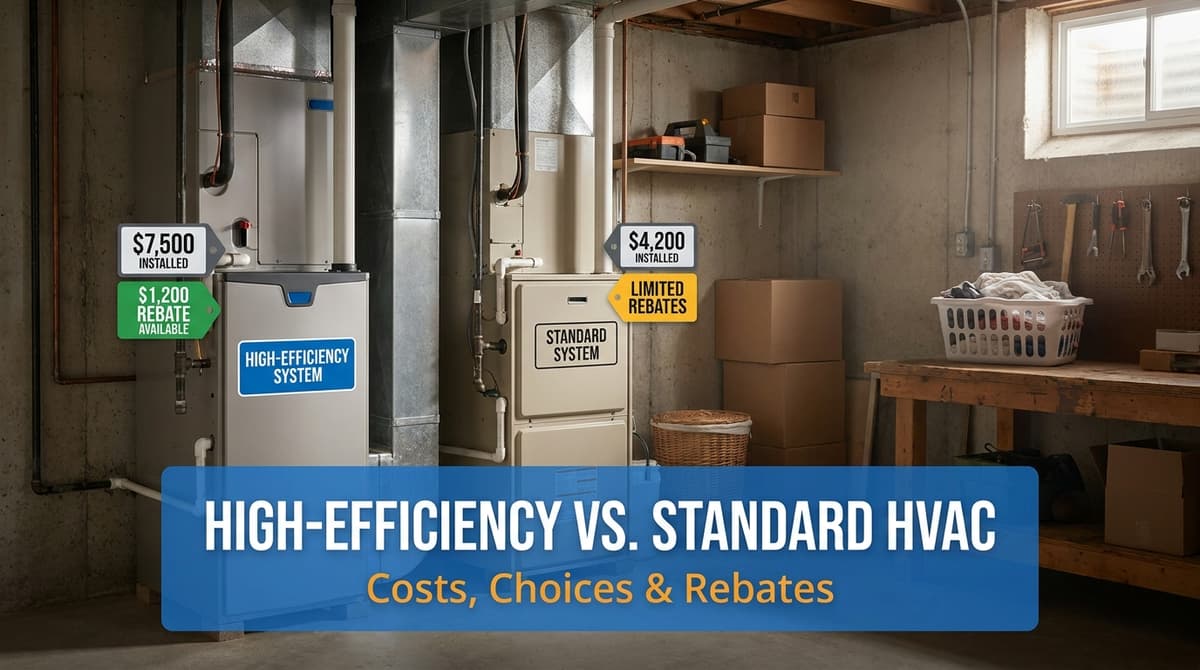
Helping a Homeowner Compare High-Efficiency vs. Standard Systems
We recently got a call from a homeowner — let’s call him Mike — who was trying to make sense of three different estimates we’d given his family for a new furnace and AC. His wife had seen the latest quote and thought the numbers didn’t add up.
They had started with one price using a premium brand, then a lower price with a more affordable brand and standard-efficiency furnace, and then a higher price again when we switched that furnace to high efficiency. On top of that, there were utility and local rebates in the mix. No wonder they were confused.
We walked Mike through what changed between each option, why the high-efficiency furnace jumped the price, and how the rebates helped bring that cost back down. That conversation is one we have with homeowners all the time, so we wanted to lay it out here in plain English.
Standard vs. High-Efficiency: What’s Really Different?
In Mike’s case, we were looking at a Goodman 3-ton 13-SEER AC outside with either:
- An 80% AFUE standard-efficiency furnace, or
- A high-efficiency furnace (typically 95%+ AFUE)
We had also priced a similar setup in a premium brand, which came in noticeably higher — partly for features, partly for brand name, just like Mike said about the equipment his own company sells.
How furnace efficiency is measured
AFUE (Annual Fuel Utilization Efficiency) tells you how much of your fuel actually becomes heat for your home.
- 80% AFUE furnace: About $0.80 of every fuel dollar becomes heat; $0.20 is lost up the flue.
- 95% AFUE furnace: About $0.95 of every dollar becomes heat; only $0.05 is wasted.
On paper, that 15% bump might not look dramatic, but across many winters, it can add up — especially in a cold-climate home with higher gas usage.
Why the High-Efficiency Option Costs More Up Front
Mike’s main question was simple: “If we chose a cheaper AC, why did the total price go up with the latest estimate?” The answer came down to the furnace.
When we swapped the standard 80% furnace for a high-efficiency model, the total jumped roughly from the $10,000 range to the mid-$12,000s. That surprised them, but here’s why that happens.
What drives the higher price?
- More expensive equipment: High-efficiency furnaces often cost close to double the price of a similar standard model.
- Extra installation work: High-efficiency units typically need PVC venting, a condensate drain, and sometimes flue changes, which adds labor and materials.
- Brand differences: Premium brands (like the American Standard option Mike first saw) add still more to the price compared to a value-focused brand like Goodman.
So in their case, we had a few layers:
- Premium-brand system: highest price, standard or high-efficiency furnace available
- Goodman with 80% furnace: more affordable overall
- Goodman with high-efficiency furnace: still cheaper than a premium-brand high-efficiency, but higher than the 80% option
How Rebates Help Close the Gap
The good news for Mike was that the high-efficiency furnace unlocked a couple of rebates:
- $150 NICOR gas rebate for qualifying high-efficiency equipment.
- $400 local trade rebate (through the local 265 sheet metal workers), paid as a prepaid Visa card after installation and a small processing fee.
Altogether, that’s about $550 back in Mike’s pocket once everything is processed. We provided the model and serial numbers and walked him through which forms we handle and which ones he completes online.
Rebates change by utility and region, but we almost always find that high-efficiency furnaces come with some sort of incentive. When we build estimates, we like to show both the gross cost and the net cost after rebates so it’s clear what you’re really paying.
Simple Payback: When Does High Efficiency Actually Pay Off?
A question we didn’t want to leave unanswered for Mike was: “Will this extra cost ever pay for itself?” We can’t give exact numbers without seeing your bills, but here’s a simple way to think about it.
Back-of-the-envelope payback math
Let’s say:
- The high-efficiency furnace adds $2,000 to the project.
- Rebates total $550, so your net extra cost is about $1,450.
- The high-efficiency unit saves you around $200 per year on gas (very rough estimate for a colder climate and average-sized home).
Now we estimate payback:
- $1,450 ÷ $200 ≈ 7.25 years
That’s a ballpark, not a promise — milder climates or smaller homes might see a longer payback, larger drafty homes might see a shorter one. But if you expect to be in the home for 7–10 years or more, that upgrade often makes financial sense.
Brand vs. Efficiency: Which Matters More?
Mike also wanted to know if choosing Goodman over a premium brand meant he was “cheapening out.” We were honest with him, just like we are with everyone else.
- Premium brands typically offer more advanced features, tighter integration, and sometimes quieter operation. You do pay a “badge” premium, much like Mike sees in his own industry.
- Value brands like Goodman can be very solid when properly sized and installed. We’ve put the same equipment in our own families’ homes because we trust it.
For most homeowners, the bigger financial decision is efficiency level and quality of installation, not the nameplate on the cabinet.
Which Option Fits Your Situation?
Not every home or budget points to the same answer. When we sat with Mike, we walked through scenarios like these — the same ones we’d walk through with you:
Smaller home, tight budget
- A modest-sized, well-insulated home with relatively low gas bills.
- Family watching every dollar on the project.
In this case, a standard 80% furnace with a reliable AC can be a smart choice. The yearly gas savings from going high-efficiency may be too small to justify the higher upfront cost.
Larger home, high winter gas bills
- Bigger square footage, older windows, or drafty construction.
- Gas bills that really jump in the coldest months.
Here, a high-efficiency furnace often shines. The more you spend on fuel, the more that extra 10–15% efficiency matters, and the faster your payback period gets.
Planning to move in 3–5 years
- You know you’ll likely sell in the near future.
- You want reliability and comfort but aren’t sure how long you’ll benefit from any savings.
If Mike had told us he was moving soon, we might have leaned more toward the standard-efficiency furnace unless rebates were especially strong. You may not be in the house long enough to see the full return, though a newer high-efficiency system can be a selling point.
How We Help You Compare Your Options
We could tell from Mike’s call that most of the frustration came from confusing quotes, not from the actual equipment choices. That’s on us as contractors to fix.
When we put together options, we aim to clearly spell out:
- Brand and model for the furnace and AC.
- Efficiency ratings (AFUE for furnace, SEER/SEER2 for AC).
- Total installed price before incentives.
- Estimated rebates and who handles the paperwork.
- Rough operating cost comparison so you can see potential savings.
If you’re staring at multiple HVAC bids and they all read differently, we’re always happy to walk through them with you, line by line, the same way we did with Mike and his wife. Once the numbers and terminology make sense, the right choice for your home usually becomes a lot clearer.